
Artist Spotlight: Marie Zolamian
Confabulations with Marie ZolamianPt. 1
artPost21 was founded in 2012 to ‘signpost’ contemporary visual culture from the ‘seeming’ margins across the field of discourse. Our first project involved an exercise in producing merch-couture; an attendant fashion show, a cabaret evening, and a festival. Since then, our focus has been on archiving and building collections of knowledge—books, group exhibitions, and developing organizational structures— pulling together pieces of history from various points in time, with a view to encouraging our friends, to look again.
We used to be a big collective. Now we are only a couple of individuals volunteering time. With the support of friends, trustees, and whomever else is willing, we try to support visual literacy through acts of dreaming and world-making. As we shifted our focus to our archival and collecting work, in 2025, we presented the first Blake Gallacher Acquisition. This has been named in honor of two very important people to me and my partner. The poet: Blake Karim Mitchell, with whom my late friend Koyo Kouoh afforded me the courage and confidence to collaborate, Jane Gallacher, my mother-in-law, who at the time of writing, is in the later stages struggling in her battle with Alzheimer’s.
As the acquisition arrived at its new ‘home’ in the UK, it transpired that the artist who had fired and stirred our imagination, the Lebanese-Belgian artist, Marie Zolamian, was also on the eve of opening a major survey exhibit of paintings at Wiels, Brussels entitled, Confabulations, and had also prepared their first monograph, Le Jardin Sans Soleil published by Posture Editions. What a momentous occasion then to dive-in, and learn more about our new acquisition, Thaumaturge and Marie Zolamian.
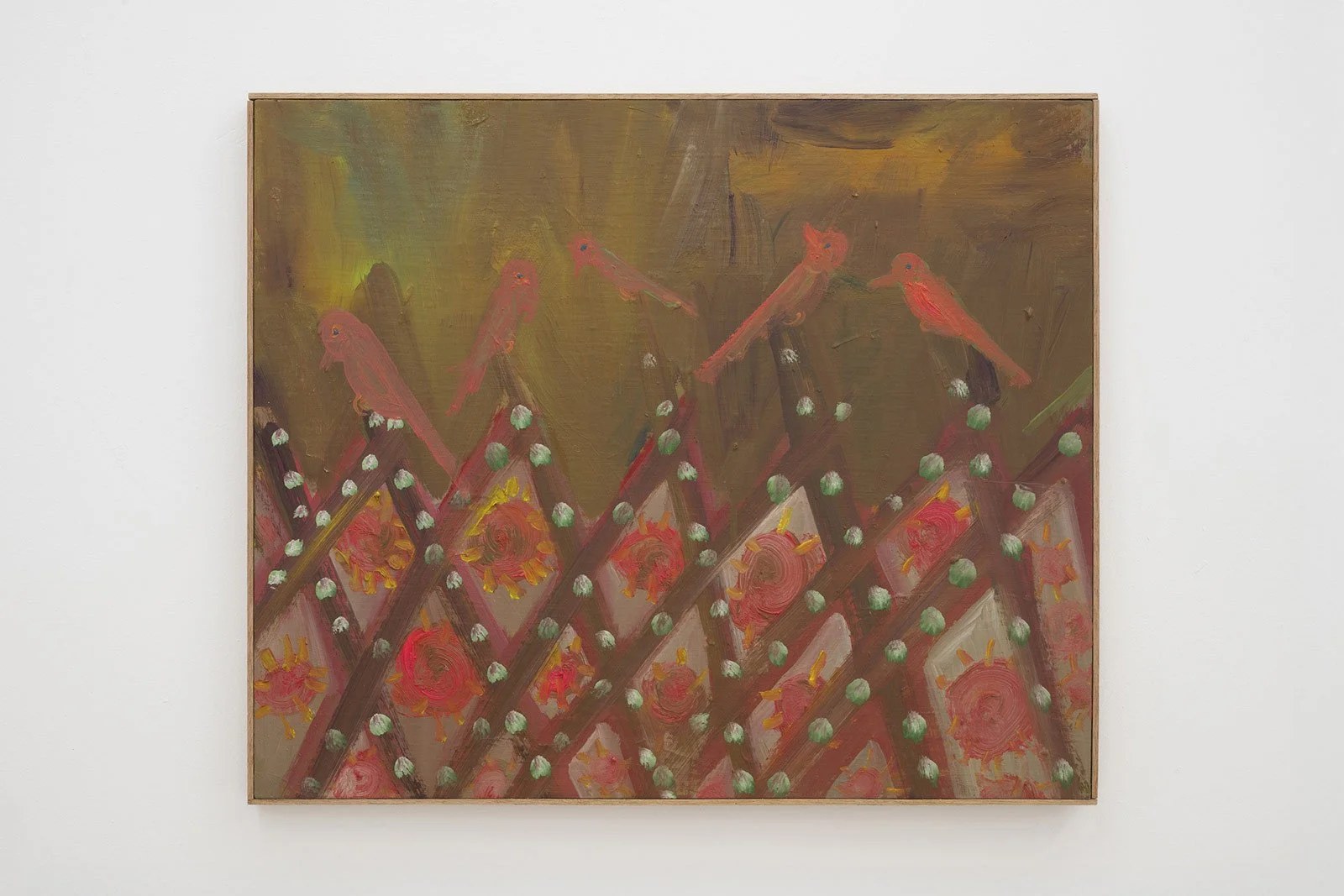
Marie Zolamian, Vitupérer, 2025. Oil on linen on panel, 50 x 60 cm. Photo: Roberto Ruiz.
Omar Kholeif: Your work, which spans the gamut from painting and drawing; moving-image, sound and everything in-between. At times they might seem to evoke narrative formations, but they are also lurid, surrealist settings that can only be conjured from the imagination. Could you speak a little to the process of how you arrive to work, or do the works often arrive to you?
Marie Zolamian: I work in different ways depending where I am: in commission, on trips, in the studio. Each nourishes the other. They develop through situated research and are permeated by, and remain porous to, the research itself, conducted by readings, exhibitions, artists’ writings, essays, films, series, documentaries, encounters and current events. The different mediums respond to different necessities. When I am on the move, drawing, notebooks, and sometimes sound receive immediacy and unfold with the speed of reflexive and instantaneous thoughts.
Painting requires a different duration, a preparation, an almost ceremonial setting in place. The support becomes a ground of preparation, a place of welcome, a space prepared for exploration. Painting imposes a slow and hyper-concentrated temporality. It engages the gestures that come before the image: the panel, the linen, the rabbit-skin glue, the thin layers of ground, then the interweaving of the oils. These gestures already carry the memory of painting. I do not have a preconceived idea before painting, it all comes during the act.
But, before arriving in the painting space, I read, I watch, I listen, I draw. After an hour or two, I leave everything behind me and take with me this inner reservoir to meet the unknown and plunge in the painting process with my intuition, unconsciousness, sensation, imagination and memory.
“I paint in the present, including what returns from memory and what imposes itself from outside, what enters through impregnation and porosity.”
When I paint, I am surrounded by dozens of marouflaged panels, on the floor, on the walls, on the tables. I move from one painting to another. I paint standing up, in motion, in a continuous flow of gestures that are at once fragile, frenetic and decisive, often without stopping for two or three hours. The brushes travel and my body follows.
“I go looking for the paint.”
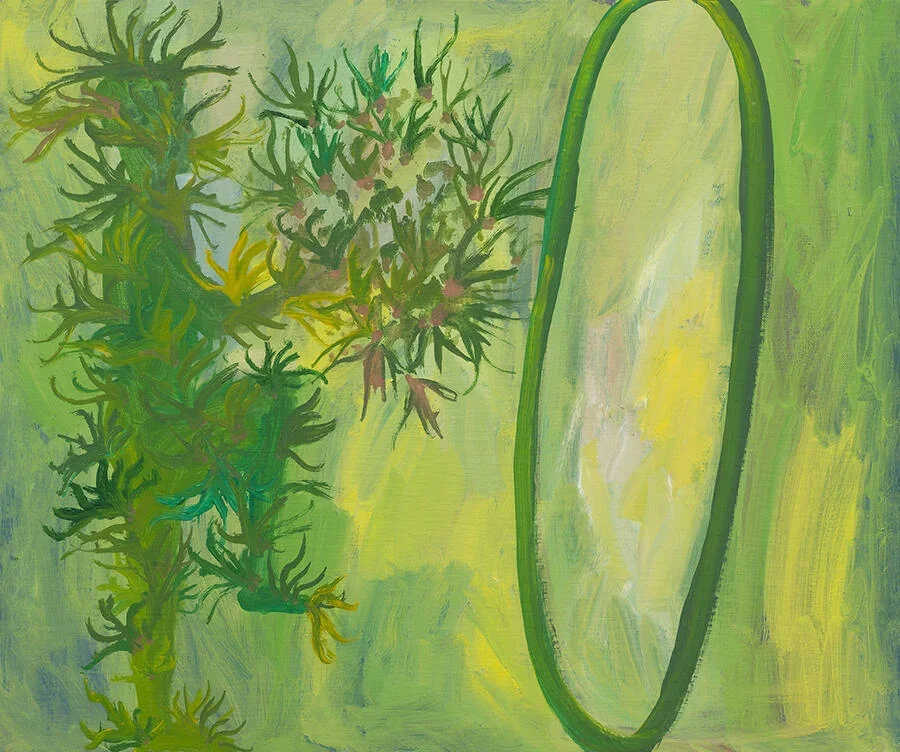
Marie Zolamian, Ensuquer (Ensue), 2024, oil on canvas on panel, 51 × 61 cm. Photograph: Roberto Ruiz.
I play with a mixture of several colours, I place the soaked brush, more or less diluted, on a surface. The gaze barely opens to observe the encounter between this intervention and the other coloured forms on the same surface. Depending on the necessity, either I go looking for other colours to continue the conversation here, or I deposit this same mixture on another surface, and so on. I listen to what happens between forms and colours. There is a continuum of gestures, breaths, decisions. A dialogue. A polyphony. When painting, I try to find a space in which to enter. I always begin from a recommencement, from a moment when I do not yet know what to paint, nor how to paint. It is in this state of openness that images can arrive, become absorbed, and find their form.
Forms, creatures, and landscapes gradually appear, and I become acquainted with them in the course of the act of painting. Colour plays a driving role here. It gives movement, it lets the scene appear as it unfolds. The narrative question interests me on the condition that it remains open. I like images in the process of being made, in the process of unfolding. I like multiple endings, sequences that allow meaning to circulate rather than closing them down.
“That is why I often think of the work as a consciously unconscious montage: a succession of acts, planes, fragments, with breaths, gaps, silences.”
I would not say that the works arrive to me, nor that I fully construct them. They take form within a tension between intention and openness. What I try to maintain is a condition where the image can exceed what I could have projected onto it while doing. Each painting becomes a way of encountering the unknown.
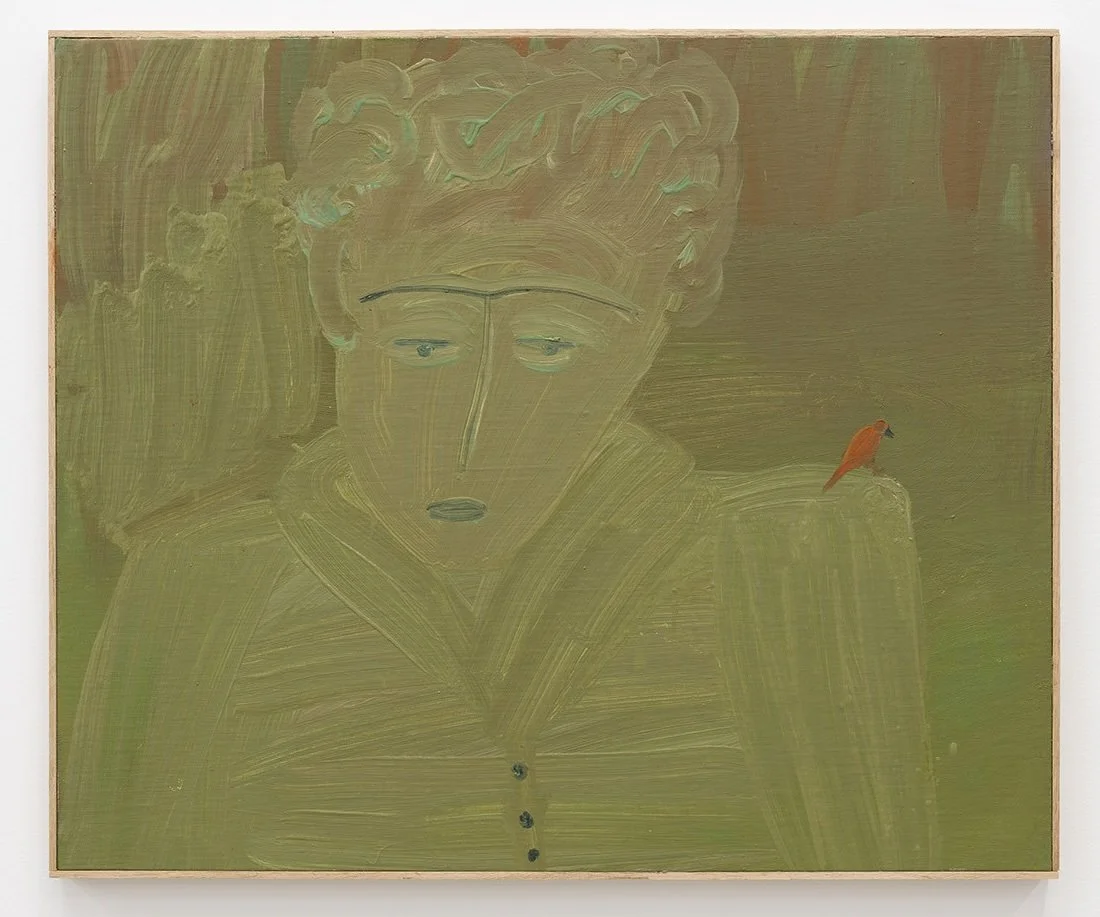
Marie Zolamian, Thaumaturge, 2024. Oil on linen on panel, 51 x 61 cm. Photo: Roberto Ruiz. Courtesy the artist and Bombon Projects, ‘The Dreamwork Collection’, C/O artPost21.
OK: Thaumaturge as a painting is a composite of a particular set of layered memories; can you say a little about this?
MZ: “Thaumaturge”. The composition came all at once on a canvas that was already coloured and dry, from another painting session. While painting I thought of a self-portrait, but the green colour and the white-blue shades in the hair made me think of my grandmother. Since the whole was dark, I wanted to counterbalance it with a small vermilion red spot. The bird appeared, like a thought both to the spirit of my grandmother and to the song
“The Bird at the Window” by Fairouz, which I used to hum without knowing its meaning. On layered memories. The painting is a condensation of the transformation of a field of memory that have sedimented over time in different temporalities and geographies. Imagination in the present produces a space where familiar and unfamiliar can coexist without being stabilized. One form absorbs another, displaces it, metabolizes it, until a new space begins to appear.
Memory works in that way in my practice: it remains more or less active, it circulates, it changes form through art. Painting then becomes a pictorial organ in which multiple temporalities and multiple image regimes coexist. Memory becomes living matter, transformed by colour, by gesture, by collisions, by the appearance of an elsewhere.
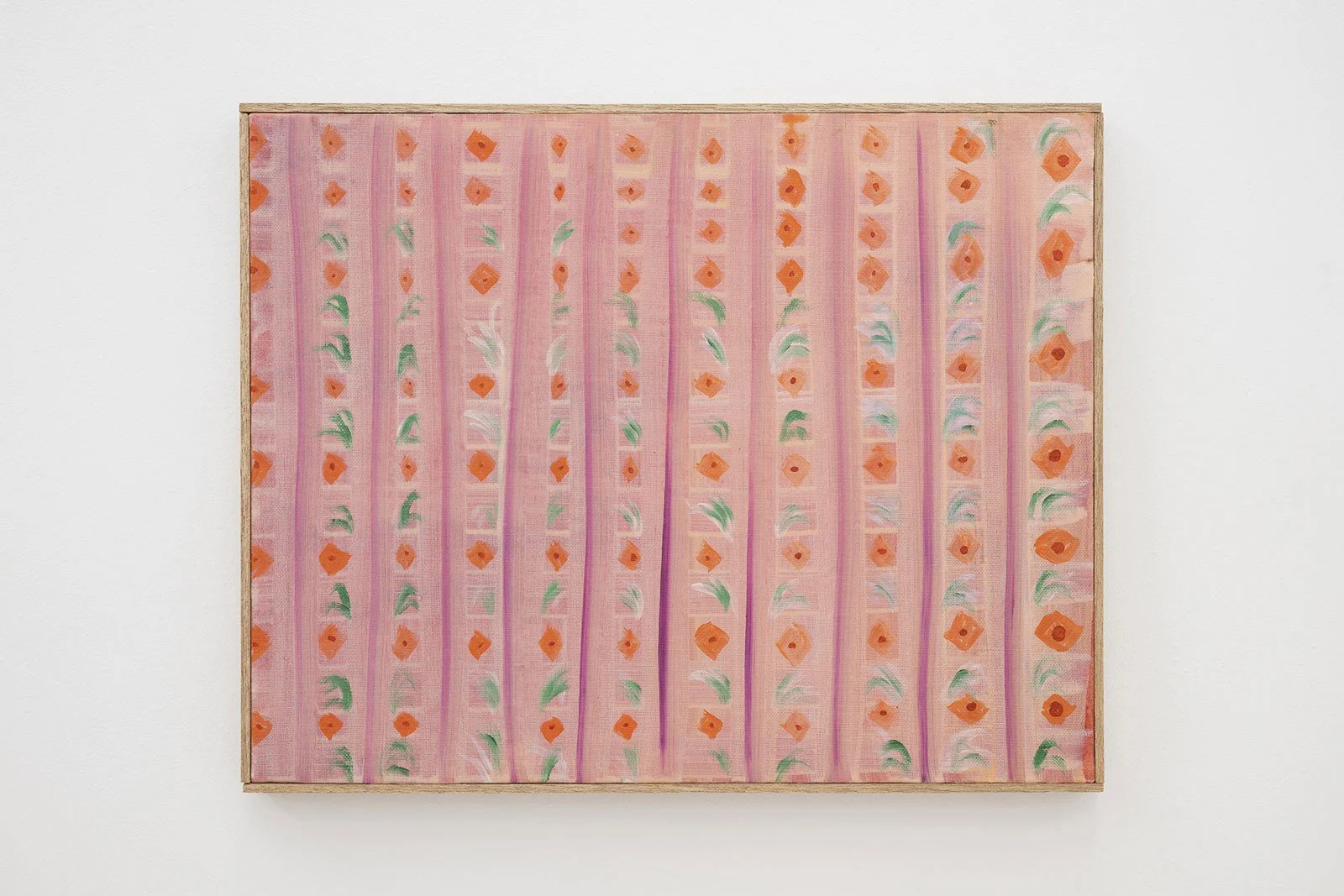
Marie Zolamian, Brocatelle, 2025. Oil on linen on panel, 30 x 40 cm. Photo: Roberto Ruiz.
OK: There is a perpetual sense of reflection in your image-making, an invitation to the spectator to complete the question; to speak to the picture, an act of summoning. Do you think of your works are situated sites for a “shared history” to emerge and to be reflected upon?
MZ: I would speak of the possibility of a shared space of attention and concentration. Each surface can be seen as a field where different memories, projections, and interpretations encounter one another, coexist and perform a new combination. They can invite the spectator to enter into relations with this activated space, where circulation continues between the image and the one who looks at it. The image, as I seek it, opens up a field in which multiple memories, multiple intensities, and multiple (visual) languages can coexist. It welcomes and echoes rather than explains. It brings into relation rather than articulates a single narrative. When I look at a painting, what interests me is the history of the traversed path, the moment of the act of painting as the condensation of the relationship between that moment, the painting and the painter.